
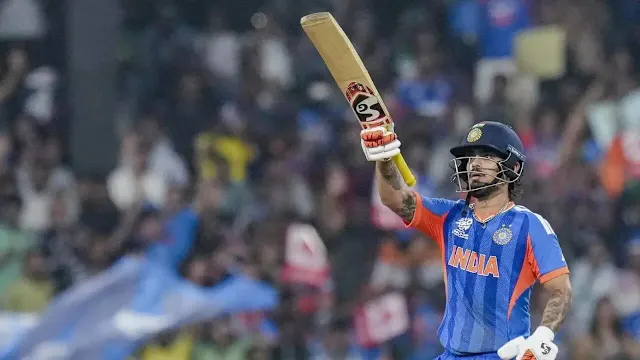
It didn’t feel like a normal India–Pakistan match from the start.
There was tension in the air, a slow turning pitch under lights in Colombo, and a Pakistan bowling attack that had come in with a clear plan: choke India early with spin. No pace. No freebies. Just pressure.
And for a few overs, it almost worked.
India lost a wicket early. The ball was gripping, turning, misbehaving. Ishan Kishan himself looked unsettled — one big hit, then a close edge, then a couple of mistimed shots that fell safely. It was the kind of start where you’re never sure whether a batter will settle or self-destruct.
Then Abrar Ahmed bowled that first leg-spinner into Kishan’s arc.
Kishan didn’t hesitate. He slog-swept it hard, flat, and clean into the stands. The sound off the bat cut through the noise in the stadium. Suddenly, Pakistan’s plan didn’t look so clever anymore.
From that moment, the innings changed its tone.
Kishan began to read the spin early. He wasn’t just swinging — he was choosing his shots. One over he went over midwicket, the next he pierced the covers. When the field spread, he didn’t slow down. He accelerated. Reverse sweeps came out. Length balls disappeared. Bowlers who were meant to control the middle overs were suddenly defending boundaries.
What made the innings special wasn’t just the runs — it was when they came. On a pitch where others struggled to score at run-a-ball, Kishan was scoring at will. Pakistan bowled almost exclusively spin while he was at the crease, trusting the surface. Kishan trusted himself more.
By the time he was dismissed in the ninth over, India were already cruising. The damage was done. His 77 off 41 balls wasn’t flashy padding at the end — it was front-loaded destruction. At one point, he had scored almost all of India’s runs. The rest of the batting lineup simply had to make sure they didn’t undo his work.
This innings matters because of what it represents.
Not long ago, Kishan was out of the Indian side. He was seen as talented but flawed, especially against spin. Instead of complaining, he went back to domestic cricket, captained Jharkhand, piled on runs, and forced his way back the hard way.
Against Pakistan, in a World Cup, on a difficult surface, he showed how far he’s come.
It also matters for India. Big tournaments are often defined by moments — one innings that changes belief inside the dressing room. This felt like one of those. Pakistan weren’t just beaten; they were overpowered early, and that shaped everything that followed.
Long after the points table changes and the tournament moves on, this innings will still be remembered. Not because it was loud or dramatic — but because it was fearless, timely, and completely match-defining.
That’s how World Cup stories are written.
Comments (0)
No comments yet.